Promo code APP3 – € 3 discount on your first order in app
  Free delivery for orders over € 49


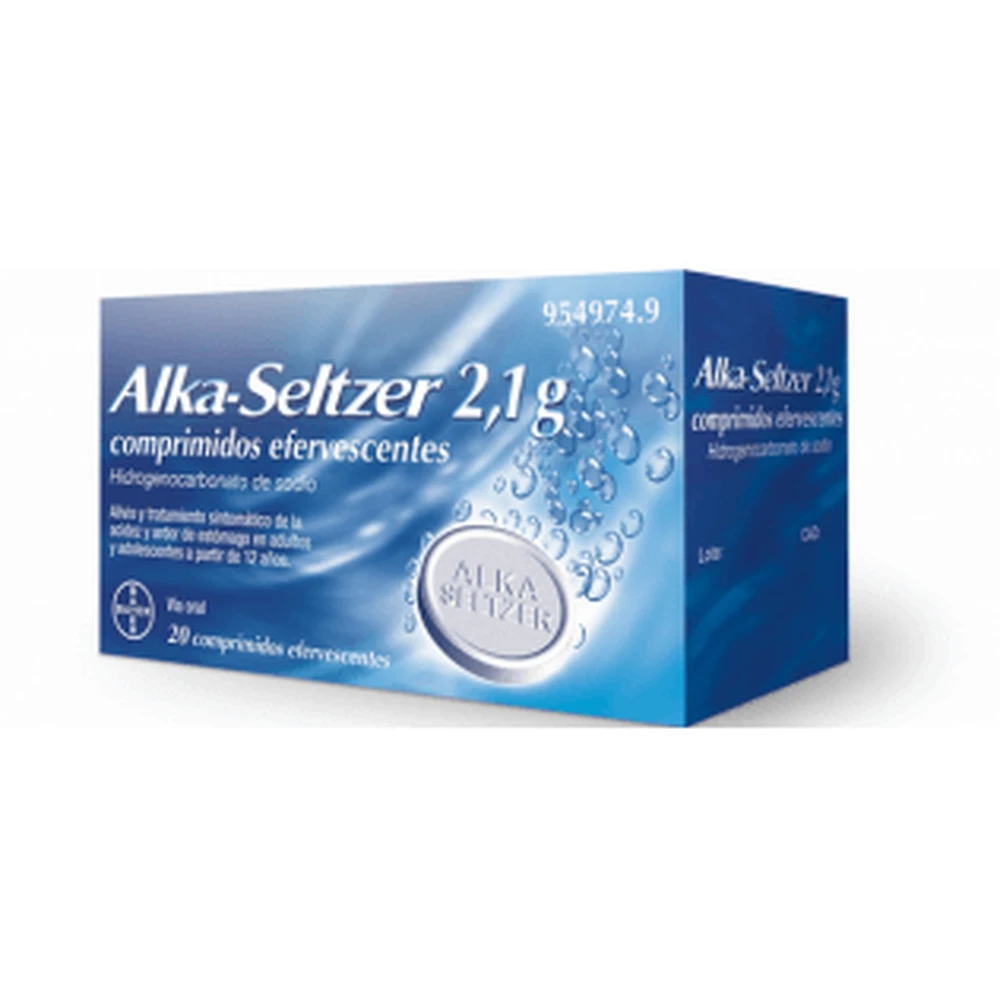
ALKA-SELTZER 2.1 G 20 EFFERVESCENT TABLETS
Description
ACTION AND MECHANISM
Absorbable [ANTACID] (sodium). Sodium derivative. Acts by neutralizing hydrochloric acid in the stomach, increasing gastric pH, which also reduces the formation and activity of pepsin. Urinary alkalizing and systemic alkalizing agent.
SPECIAL WARNINGS
- Patients should be monitored for possible milk-alkali syndrome if used during prolonged treatment. - Bicarbonate can dissolve enteric-coated pharmaceutical forms in the stomach, so it is advisable to take this medicine 1 hour before or 2 hours after taking the enteric-coated medicine. - Sodium salts, such as sodium bicarbonate, can produce rebound acidity by increasing gastrin secretion and gastric secretion in response to the large increase in gastric pH they produce. - This medicine should not be taken immediately after excessive food or drink, as this may cause increased CO2 production, which would lead to gastric distension and, in rare cases, may perforate the stomach walls.
SENIORS
Use in people over 65 years of age: do not exceed 3 tablets.
PATIENT ADVICE
- Should not be used for more than 14 days. If symptoms worsen or persist for more than 14 days, consult a doctor. - Do not exceed 6 tablets per day. - The sodium content of this medicine may increase fluid retention and blood pressure, which should be taken into consideration in patients with hypertension or heart failure. - Do not take with milk.
PREGNANCY
- Due to its systemic absorption, its use is not recommended during pregnancy and lactation.
INDICATIONS
[GASTRIC HYPERACIDITY]: Symptomatic relief of occasional gastric discomfort related to hyperacidity.
INTERACTIONS
- Amphetamine, dexamfetamine: studies have shown a possible potentiation of their effect due to alkalinization of urine, which prolongs their half-life. - Antiarrhythmics (flecainide, quinidine): studies have shown a possible potentiation of their toxicity due to a decrease in their excretion due to alkalinization of urine. - Emergency contraceptive based on ulipristal acetate: increased gastric pH may reduce plasma concentrations of the contraceptive, decreasing its efficacy. Concomitant use is not recommended. - NSAIDs (flufenamic or mefenamic acid, indomethacin): studies have shown a decrease in their absorption with some antacids (algeldrate, magnesium oxide, calcium carbonate). - Beta-blockers (propranolol, atenolol): there are studies with some antacids (algeldrate, magnesium hydroxide) in which a decrease in absorption has been recorded due to a decrease in the dissolution of the beta-blocker, so it is recommended to space out their administration.- Digitalis (digoxin, digitoxin): there are studies with some antacids (algeldrate, magnesium hydroxide) in which a decrease in the absorption of digitalis has been recorded, so it is recommended to space out their administration by 2 or 3 hours.- Ephedrine, Pseudoephedrine: there are studies in which the possible appearance of toxicity has been recorded, due to a decrease in its excretion due to alkalinization of the urine.- Erythromycin: there is a study in which an increase in activity has been recorded due to alkalinization of the urine.- Erlotinib: possible reduction in erlotinib levels, due to a reduction in its absorption. Antacids increase gastric pH, which may decrease erlotinib solubility, absorption, and therapeutic effects. It is recommended that they be administered at least 4 hours before or 2 hours after the daily dose of the anticancer agent. - Gabapentin: Some decrease in gabapentin levels has been observed when administered concomitantly with or within two hours of taking other antacids, due to increased pH. It is recommended to administer gabapentin 2 hours before an antacid.- Ketoconazole: there are studies in which a possible decrease in absorption has been recorded.- Methadone: there are studies in which a decrease in excretion has been recorded due to alkalinization of the urine.- Methotrexate: there are studies in which an increase in the excretion of methotrexate has been recorded due to alkalinization of the urine.- Naproxen: there are studies in which a possible increase in absorption has been recorded.- Quinolones (ciprofloxacin, norfloxacin): there are studies with some antacids (algeldrate, almagate) in which a decrease in their absorption has been recorded due to the formation of insoluble, non-absorbable complexes at the intestinal level, so it is recommended to separate their administration by 2 or 3 hours.- Rifampicin: there is some study in which a possible decrease in its serum levels has been recorded due to modifications in its solubility due to variations in gastric pH. - Iron salts (citrate, fumarate, iron sulfate): there are studies with some antacids (algeldrate, magnesium trisilicate) in which a decrease in absorption has been recorded due to the formation of poorly soluble complexes, so it is recommended to space out administration by 2 or 3 hours. - Lithium salts (lithium carbonate): there are studies in which a possible increase in its renal excretion has been recorded with loss of antimanic activity, because part of the sodium can be reabsorbed instead of lithium. - Salicylates (ASA): there are studies in which a decrease in salicylate levels has been recorded, due to greater excretion due to alkalinization of the urine. - Tetracyclines (tetracycline): there are studies in which a possible formation of non-absorbable complexes at the gastrointestinal level has been recorded, thus decreasing their absorption, so it is recommended to space out administration by 2 or 3 hours.
LACTATION
- Due to its systemic absorption, its use is not recommended during pregnancy and lactation.
CHILDREN
It should not be administered to children under 12 years of age as there is not enough experience in this population group.
RULES FOR CORRECT ADMINISTRATION
Take 20 minutes to 1 hour after meals. Do not use for more than 2 weeks.
* Effervescent tablets: Take dissolved in a glass of water after the fizzing has stopped, to reduce abdominal distension. It is recommended to remove the tablets from the strip immediately before administration.
* Powder: dissolve in half a glass of water.
* Tablets: Take with a little water.
POSOLOGY
Oral route: - Adults and children over 12 years: the usual dose is 1 effervescent tablet, if necessary increase to 2, after meals or when experiencing gastric discomfort. Always use the lowest effective dose. Do not exceed 6 tablets in 24 hours.
DOSAGE IN KIDNEY FAILURE
- Should be used with caution.
PRECAUTIONS
[KIDNEY FAILURE]. In cases of kidney failure, sodium may accumulate, which can lead to hypernatremia and increased fluid retention.[HEART FAILURE]. Sodium can cause hypernatremia, which leads to alterations in the Na+-K+ ATPase pump, decreasing the effectiveness of cardiac contraction. Furthermore, water retention can generate hypervolemia, which increases preload and further impairs heart function.[ARTERIAL HYPERTENSION]. The sodium content of this medicine may increase fluid retention and blood pressure.[METABOLIC ALKALOSIS], [RESPIRATORY ALKALOSIS]. Sodium bicarbonate is a systemic antacid that is absorbed in the gastrointestinal tract, so its prolonged use may lead to metabolic alkalosis.
PRECAUTIONS RELATED TO EXCIPIENTS
- This medicine contains aspartame as an excipient, so it should be taken into account by people suffering from [PHENYLKETONURIA]. 100 mg of aspartame corresponds to 56.13 mg of phenylalanine.
ADVERSE REACTIONS
The adverse effects of sodium bicarbonate are generally infrequent although moderately important if high doses are used or during prolonged treatment. - Gastrointestinal: Occasionally, [FLATULENCE], belching, vomiting, cramps, stomach distension and heartburn as a rebound effect. - Metabolic: With large doses it can produce [METABOLIC ALKALOSIS] (more frequent in the case of renal failure), [HYPERNATREMIA] and an increase in serum lactate. If a large quantity of milk is ingested (high calcium ion content) it can lead to milk-alkali syndrome, with hypercalcemia (anorexia, nausea, vomiting, apathy, muscle cramps), which can manifest several weeks after the start of treatment. - Cardiovascular: Due to sodium absorption, risk of [EDEMA] and [ARTERIAL HYPERTENSION] with high doses or prolonged treatment.
OVERDOSE
Ingestion of large amounts of sodium bicarbonate can cause metabolic alkalosis and fluid retention. Symptoms include headache, dizziness, ringing in the ears, blurred vision, drowsiness, sweating, nausea, vomiting, occasionally diarrhea, hyperirritability, and tetany (the latter characteristic of patients with hypocalcemia).
COMPOSITION
SODIUM BICARBONATE: 2081.8 MILLIGRAMS
ASPARTAME (E-951) (EXCIPIENT): 10 MILLIGRAMS
SODIUM SALTS (EXCIPIENT): 570 MILLIGRAMS
Features
| Product code | 506181 |
| Category | Meteorism, Digestive Diseases |
| Product line | Alka-Seltzer |
| Brand | Bayer |
| Quantity | 20 |
| Delivery from | Spain |
ALKA-SELTZER 2.1 G 20 EFFERVESCENT TABLETS
ALKA-SELTZER 2.1 G 20 EFFERVESCENT TABLETS
Delivery from Spain


Leave your email, and we’ll let you know as soon as it’s back in stock!
Recently viewed products





Reviews

ALKA-SELTZER 2.1 G 20 EFFERVESCENT TABLETS
 Earn € 1 Reward for every review
- For each submitted and approved review you can earn € 1 Reward on your Rewards Credit.
- Rewards are given once for each purchased product you have reviewed.
- You have to be authorised to receive Rewards
All reviews

There are no reviews for this product.










 Description