Promo code APP3 – € 3 discount on your first order in app
  Free delivery for orders over € 49


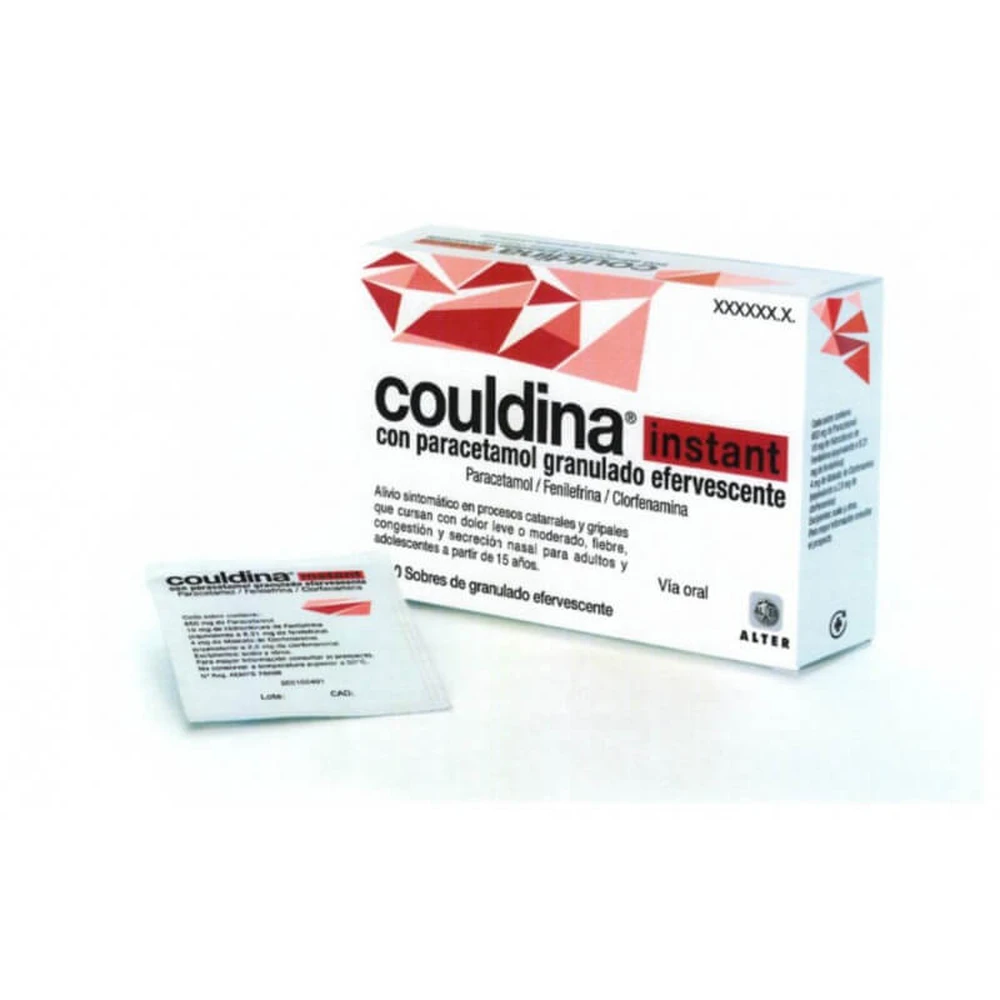
Couldina Instant with Paracetamol 650/4/10 mg 20 Sachets
Description
ACTION AND MECHANISM
- Flu medication.
* Paracetamol: analgesic and antipyretic, probably due to the inhibition of cyclooxygenase at the central level, especially COX-2, decreasing the synthesis of prostaglandins.
* Chlorphenamine: an H1 antihistamine and anticholinergic. It reduces cold symptoms such as sneezing, watery eyes, and runny nose.
* Phenylephrine: alpha-1 adrenergic agonist. Produces vasoconstriction, reducing nasal congestion.
SPECIAL WARNINGS
- If the patient experiences difficulty urinating or urinary retention, it is recommended to discontinue treatment.
- Patients who are going to undergo allergy testing using allergenic extracts should discontinue treatment at least 72 hours beforehand to avoid false negatives.
SENIORS
No specific problems have been described in the elderly that would require a dosage adjustment.
However, these patients may be more sensitive to the side effects of this medication, so it is advised to use it with caution, paying particular attention to the appearance of anticholinergic effects.
PATIENT ADVICE
- Avoid drinking alcohol during treatment.
Do not exceed the recommended dose. Taking other drugs with paracetamol could lead to very serious poisoning.
- Consult your doctor and/or pharmacist if pain continues after 5 days of treatment, fever lasts for more than 3 days, or symptoms worsen or new ones appear.
- Avoid driving or performing activities that require your attention until you are sure that the treatment does not negatively affect you.
- Inform your doctor and/or pharmacist if you are going to undergo allergy diagnostic tests.
- Inform your doctor and/or pharmacist if you experience any of these symptoms:
* Dry mouth, visual disturbances, constipation, or inability to urinate.
CONTRAINDICATIONS
- Hypersensitivity to any component of the medication, including [PARACETAMOL ALLERGY]. Cross-hypersensitivity reactions may occur between different antihistamines.
- Conditions that may be aggravated by this medication, such as [HIGH PRESSURE], [PHEOCHROMOCYTOMA], [HYPERTHYROIDISM], [ISCHEMIC HEART DISEASE], [TACHYCARDIA], [GLAUCOMA] or [DIABETES].
- Severe renal insufficiency (ClCr < 30 ml/min) or severe hepatic insufficiency (Child-Pugh class C).
- [PORPHYRIA]. H1 antihistamines have been associated with the onset of porphyric attacks, so they are not considered safe in these patients.
- Patients undergoing treatment with an MAOI in the previous 14 days (see Interactions; antidepressants).
- Treatment with beta-blockers or other sympathomimetics.
EFFECTS ON DRIVING
It may cause significant sedation due to the presence of chlorphenamine. Patients should avoid operating dangerous machinery, including automobiles, until they are reasonably certain that the medication does not adversely affect them.
PREGNANCY
FDA Category:
- Paracetamol: B.
- Chlorphenamine: C.
- Phenylephrine: C.
Animal safety: Phenylephrine was associated with increased fetal mortality and premature birth in rabbits, as well as decreased blood flow to the uterus in sheep.
Studies with paracetamol in animals have not shown any cases of malformations or fetotoxic effects.
Safety in humans: There are no adequate and well-controlled studies in humans. Its administration is only acceptable if there are no safer therapeutic alternatives, and the benefits outweigh the potential risks.
Effects on fertility: no specific studies have been conducted in humans.
INDICATIONS
- Symptomatic treatment of [COMMON COLD] or [FLU] with mild or moderate pain, fever, nasal congestion and discharge in adults and adolescents 15 years and older.
INTERACTIONS
- Ethyl alcohol. Ethyl alcohol may enhance the sedative effects of this medicine. In addition, consuming alcoholic beverages with paracetamol may cause liver damage. It is recommended to avoid alcohol consumption during treatment. In chronic alcoholics, no more than 2 g/24 hours of paracetamol should be administered.
- Alpha blockers (ergotamines for migraines, oxytocin). Their simultaneous use is not recommended because it may increase vasoconstrictive effects. Alpha blockers used for hypertension or benign prostatic hyperplasia, because they do not block beta receptors, may cause an increased risk of hypotension and tachycardia.
- Inhaled anesthetics (halothane). May increase the risk of arrhythmias.
- Oral anticoagulants. In very rare cases, usually with high doses, the anticoagulant effects could be potentiated by paracetamol's inhibition of hepatic synthesis of clotting factors. It is recommended to administer the lowest dose, for the shortest possible duration of treatment, and to monitor the INR.
- Anticholinergics (antiparkinsonian drugs, tricyclic antidepressants, MAOIs, neuroleptics). Chlorphenamine may potentiate anticholinergic effects, so this combination should be avoided.
- Oral contraceptives. They could increase the plasma clearance of paracetamol, decreasing its effects.
- Tricyclic antidepressants (amitriptyline, amoxapine, clomipramine, desipramine, doxepin, maprotiline). Their simultaneous use may potentiate the pressor effects of phenylephrine.
- Antihypertensives (beta-blockers, diuretics, guanethidine, methyldopa). Phenylephrine may antagonize the antihypertensive effects and even lead to hypertensive crises; therefore, monitoring of blood pressure is recommended. Propranolol may inhibit the metabolism of paracetamol, leading to toxic effects.
- Atropine. Blocks reflex bradycardia caused by phenylephrine and increases the pressor response to phenylephrine.
- Activated charcoal. It can adsorb paracetamol, decreasing its absorption and pharmacological effects.
- Chloramphenicol. The toxicity of chloramphenicol could be potentiated, probably by inhibition of its metabolism.
- Digitalis. The risk of cardiac arrhythmias associated with phenylephrine may be increased.
- Diuretics that can cause hypokalemia (furosemide). Hypokalemia may be exacerbated, and arterial sensitivity to vasopressors such as phenylephrine may be decreased.
- Nervous system stimulants (amphetamines, cocaine, xanthines). Nervous system stimulation could be enhanced, leading to intense excitability.
- Thyroid hormones. There could be an potentiation of the effects of both drugs, with a risk of high blood pressure and coronary insufficiency.
- MAOIs. MAOIs may potentiate the effects of phenylephrine by inhibiting the metabolism of norepinephrine, increasing the risk of hypertensive crises and other cardiac events. It is recommended to avoid administering this medication to patients treated with MAOIs within the previous 14 days.
- Enzyme inducers. Drugs such as barbiturates, carbamazepine, hydantoin, isoniazid, rifampicin or sulfinpyrazone, could induce the metabolism of paracetamol, decreasing its effects and increasing the risk of hepatotoxicity.
- Lamotrigine. Paracetamol may reduce serum concentrations of lamotrigine, resulting in a decrease in its therapeutic effect.
- Levodopa. The administration of levodopa together with sympathomimetics increases the risk of cardiac arrhythmias, so a reduction in the dose of the adrenergic agonist may be necessary.
- Metoclopramide and domperidone. They increase the absorption of paracetamol in the small intestine, due to the effect of these medications on gastric emptying.
- Probenecid. Increases the plasma half-life of paracetamol by decreasing the degradation and urinary excretion of its metabolites.
- Ion exchange resins (cholestyramine). Decreased absorption of paracetamol, with possible inhibition of its effect, due to binding of paracetamol in the intestine.
- Nitrates. Phenylephrine may antagonize the antianginal effects of nitrates, so this combination should be avoided.
- Sedatives (opioid analgesics, barbiturates, benzodiazepines, antipsychotics). The sedative effects could be potentiated.
- Sympathomimetics. An increase in side effects, both nervous and cardiovascular, may occur.
- Zidovudine. Although a possible potentiation of zidovudine toxicity (neutropenia, hepatotoxicity) has been described in isolated patients, there does not appear to be any kinetic interaction between the two drugs.
LACTATION
Excretion in milk:
- Paracetamol: small amounts (similar to maternal cp).
- Chlorphenamine: unknown. Other antihistamines do.
- Phenylephrine: limited excretion and reduced oral bioavailability.
The consequences for the infant are unknown. It is recommended to avoid administering it during breastfeeding.
CHILDREN
It can be used in adolescents from 15 years of age at the same doses as in adults.
Its use is not recommended in children and adolescents < 15 years because paracetamol doses are not adjusted to this age.
GUIDELINES FOR PROPER ADMINISTRATION
- Sachets: dissolve the contents of the sachet in half a glass of liquid, preferably water.
Administration with food: can be taken with or without food.
POSOLOGY
- Adults and adolescents > 15 years: 1 sachet/6-8 h. Maximum dose 4 sachets/24 h.
- Children < 15 years: not recommended because the paracetamol content is not adjusted to this age.
- Elderly: no specific dosage recommendations have been made. Use with caution.
Duration of treatment: Consult your doctor and/or pharmacist if symptoms persist for more than 3 days (fever) or 5 days (pain and other symptoms), or if new symptoms appear. Discontinue treatment when symptoms disappear.
Missed dose: Take the missed dose as soon as possible, unless it is almost time for the next dose. Take the next dose at the usual time. Do not double the next dose.
DOSAGE IN HEPATIC INSUFFICIENCY
- Mild to moderate hepatic impairment (Child-Pugh classes A and B): maximum dose 3 sachets/24 h, with a minimum interval between doses of 8 h.
- Severe hepatic impairment (Child-Pugh class C): contraindicated.
DOSAGE IN RENAL INSUFFICIENCY
It is not recommended because the paracetamol content exceeds the recommended dose for these patients.
PRECAUTIONS
- [RENAL INSUFFICIENCY]. In general, use is not recommended in patients with renal insufficiency, as a dosage adjustment is required which would not be possible with this medicine (see Dosage in renal insufficiency for further information).
- [HEPATOTOXICITY]. Paracetamol has been associated with hepatotoxicity when used at high doses (> 4 g/24 h) or for prolonged periods of time.
Consider its use in cases of [LIVER FAILURE], [HEPATITIS] or [LIVER CIRRHOSIS], as well as in patients with other risks of liver damage, such as [CHRONIC ALCOHOLISM], [HYPOVOLEMIA], [DEHYDRATION] or [MALNUTRITION] with low glutathione levels, or treated with other hepatotoxic drugs.
Paracetamol doses should not generally exceed 3 g/24 h.
Avoid taking other medications containing paracetamol, as well as consuming alcoholic beverages during treatment.
- [SALICYLATE ALLERGY]. Patients allergic to acetylsalicylic acid do not usually experience cross-hypersensitivity reactions with paracetamol, but cases of mild bronchospasm have been reported, so caution is advised in cases of [ASTHMA].
- Patients with pathologies that could be aggravated by anticholinergic or sympathomimetic effects, such as [CONSTIPATION], [INTESTINAL OBSTRUCTION], [HIATAL HERNIA], [GASTROESOPHAGEAL REFLUX DISEASE], stenosing [PEPTIC ULCER], [ULCERATIVE COLITIS], [HEART FAILURE], [ATHEROSLEROSIS], [PERIPHERAL ARTERIOPATHY], [ANEURYSM], [PROSTATIC HYPERPLASIA] or other causes of [URINARY RETENTION].
- Skin tests for hypersensitivity to allergenic extracts. Due to their antihistamine effects, these extracts could produce false negatives in diagnostic tests. It is recommended to discontinue administration at least 72 hours before performing the test.
- Situations that could raise body temperature. Anticholinergic drugs could interfere with the body's thermoregulatory capacity, thus potentially increasing the risk of heat stroke in patients exposed to extreme heat, especially the elderly, those who perform intense physical exercise in inappropriate clothing or at inappropriate times, or those undergoing treatment with drugs such as diuretics or others that promote dehydration.
PRECAUTIONS RELATING TO EXCIPIENTS
This medicine contains sodium salts. For the exact sodium content, please refer to the composition. Oral and parenteral dosage forms with sodium amounts exceeding 1 mmol (23 mg)/maximum daily dose should be used with caution in patients with renal impairment or on low-sodium diets.
ADVERSE REACTIONS
Adverse reactions are described according to each frequency interval, being considered very common (>10%), common (1-10%), uncommon (0.1-1%), rare (0.01-0.1%), very rare (<0.01%) or of unknown frequency (cannot be estimated from the available data).
Paracetamol RAM:
- Hepatic: rare [INCREASE TRANSAMINASES], [INCREASE ALKALINE PHOSPHATASE], [HYPERBILIRUBINEMIA]; very rare [HEPATOTOXICITY], with [JAUNDICE].
- Cardiovascular: rare [HYPOTENSION].
- Neurological/psychological: [DIZZINESS], [DISORIENTATION], [EXCITABILITY].
- Genitourinary: very rare renal alterations such as cloudy urine and kidney disorders; frequency unknown [INCREASE SERUM CREATININE], increased ammonia levels, [INCREASE BUEINE NITROGEN].
- Allergic: very rare [HYPERSENSITIVITY REACTIONS], with symptoms ranging from [EXANTHEMATOUS ERUPTIONS] and [URTICARIA] to [ANAPHYLAXIS].
- Hematological: very rare [THROMBOCYTOPENIA], [AGRANULOCYTOSIS], [LEUKOPENIA], [NEUTROPENIA], [HEMOLYTIC ANEMIA], [METHEMOGLOBINEMIA]. Prothrombin time may be increased, although it does not appear to be significant.
- Metabolic: very rare [HYPOGLYCEMIA]; frequency unknown [INCREASE LACTATE DEHYDROGENASE].
- General: rare [GENERAL DISCOMFORT].
ADR of chlorphenamine:
- Digestive: frequency unknown [NAUSEA], [VOMITING], [DIARRHEA], [CONSTIPATION], [ABDOMINAL PAIN], [DRY MOUTH].
- Hepatic: frequency unknown [HEPATITIS], [CHOLESTASIS].
- Cardiovascular: frequency unknown [PALPITATIONS], [HYPOTENSION], [HIGH PRESSURE].
- Neurological/psychological: frequency unknown [DROWSY], [DIZZINESS], facial [DYSKINESIA], [ATAXIA], [TREMOR], [PARESTHESIA], [DYSGEUSIA], [PAROSMIA].
In children and the elderly, paradoxical reactions of excitability may appear, with [AGITATION], [INSOMNIA], [NERVOUSNESS], [DELIRIUM], [CONVULSIONS].
- Respiratory: unknown frequency [NASAL DRYNESS] or throat, [SORE THROAT], thickening of mucus, [CHEST PRESSURE], [WHEEZING].
- Genitourinary: unknown frequency [URINARY RETENTION] or difficulty urinating, [SEXUAL IMPOTENCE], early menstruation.
- Dermatological: frequency unknown [HYPERHIDROSIS].
- Allergic: frequency unknown [HYPERSENSITIVITY REACTIONS], with symptoms such as [COUGH], [DYSPHAGIA], [TACHYCARDIA], [URTICARIA], facial [EDEMA] or [ANGIOEDEMA], [DYSPNEA], [FATIGUE]. Also [PHOTOSENSITIVITY REACTIONS].
- Musculoskeletal: frequency unknown [MYASTHENIA].
- Ophthalmological: frequency unknown [BLURRED VISION], [DIPLOPIA].
- Otic: frequency unknown [TINNITUS], [LABYRINTHITIS].
- Hematological: frequency unknown [AGRANULOCYTOSIS], [LEUKOPENIA], [APLASTIC ANEMIA], [THROMBOCYTOPENIA], [HEMORRHAGE].
- Metabolic: frequency unknown [ANOREXIA].
- General: unknown frequency [FATIGUE], [EDEMA].
Phenylephrine ADRs:
- Digestive: frequency unknown [VOMITING], [HYPERSALIVATION].
- Cardiovascular: frequency unknown [HYPERTENSION], [HYPOTENSION], [FLUSHING], [BRADYCARDIA], [TACHYCARDIA], [ANGINA], [PALPITATIONS], [CARDIAC ARREST].
- Neurological/psychological: frequency unknown [HEADACHE], [CEREBRAL HEMORRHAGE], [VERTIGO], [DIZZINESS], [BLUNDERNESS].
- Respiratory: frequency unknown [DYSPNEA], [PULMONARY EDEMA].
- Genitourinary: frequency unknown [HESITANT MICTURITION], [URINARY RETENTION].
- Dermatological: frequency unknown [HYPERHIDROSIS], [PARESTHESIA].
- Metabolic: frequency unknown [HYPERGLYCEMIA], [HYPOGLYCEMIA].
- General: unknown frequency, sensation of cold on the skin.
OVERDOSE
Symptoms: Overdose with paracetamol-containing products is a very serious and potentially fatal poisoning. Symptoms may not appear immediately and can take up to three days to develop. These symptoms may include confusion, excitability with restlessness, nervousness and irritability, dizziness, nausea and vomiting, loss of appetite, and liver damage. Hepatotoxicity usually manifests after 48-72 hours with nausea, vomiting, anorexia, malaise, diaphoresis, jaundice, abdominal pain, diarrhea, and liver failure.
In children, drowsiness and gait abnormalities also appear.
In the most severe cases, the patient may die from hepatic necrosis or acute renal failure.
The minimum toxic dose of paracetamol is 6 g in adults and 100 mg/kg in children. Doses exceeding 20-25 g of paracetamol are potentially fatal.
In addition to the symptoms of paracetamol overdose, symptoms of chlorphenamine overdose (deep sedation, anticholinergic symptoms) and phenylephrine overdose (excitability, seizures, tachycardia, high blood pressure) may appear.
Treatment: In case of overdose, seek immediate medical attention, as paracetamol poisoning can be fatal, even if no symptoms appear. Early identification of paracetamol overdose is especially important in children due to the severity of the condition and the availability of treatment.
In any case, gastric lavage and aspiration of stomach contents will be performed initially, preferably within four hours of ingestion. Administration of activated charcoal may reduce the amount absorbed.
There is a specific antidote for paracetamol poisoning: N-acetylcysteine. It is recommended to administer a dose of 300 mg/kg of N-acetylcysteine, equivalent to 1.5 ml/kg of a 20% aqueous solution with a pH of 6.5, intravenously over a period of 20 hours and 15 minutes, according to the following schedule:
- Adults. An initial loading dose of 150 mg/kg (0.75 ml/kg of 20% solution) will be administered by slow intravenous injection over 15 minutes, either directly or diluted in 200 ml of 5% dextrose.
A maintenance dose of 50 mg/kg (0.25 ml/kg of 20% solution) in 500 ml of 5% dextrose will then be administered by slow intravenous infusion over 4 hours.
Finally, 100 mg/kg (0.50 ml/kg of 20% solution) will be administered in 1000 ml of 5% dextrose by slow intravenous infusion over 20 hours.
- Children. The same amounts per unit of weight will be administered as in adults, but the volumes of dextrose should be adjusted based on the child's age and weight in order to avoid vascular congestion.
The antidote is most effective if administered within 8 hours of ingestion. Its effectiveness gradually decreases thereafter and is ineffective after 15 hours.
The administration of 20% N-acetylcysteine may be discontinued when blood paracetamol levels are below 200 mcg/ml.
In addition to administering the antidote, symptomatic treatment will be initiated, keeping the patient under clinical surveillance.
In the event of hepatotoxicity, it is advisable to perform a liver function study and repeat the study at 24-hour intervals.
Features
| Product code | 586293 |
| Category | Skincare and beauty, Dermatology |
| Product line | Paracetamol |
| Range | Instant |
| Quantity | 20 |
| Dose | 650 mg |
| Product type | Sachets |
Couldina Instant with Paracetamol 650/4/10 mg 20 Sachets
Couldina Instant with Paracetamol 650/4/10 mg 20 Sachets
Delivery from Spain

 24 Aug - 2 Sep

 Guaranteed delivery from Spain: 24 August - 2 September
-
€ 20,20Delivery: € 5,99 (free from € 49)
Delivery from Spain:
24 August - 2 September
-
 Pay securely with your preferred payment method













Recently viewed products









Reviews

Couldina Instant with Paracetamol 650/4/10 mg 20 Sachets
 Earn € 1 Reward for every review
- For each submitted and approved review you can earn € 1 Reward on your Rewards Credit.
- Rewards are given once for each purchased product you have reviewed.
- You have to be authorised to receive Rewards
All reviews

There are no reviews for this product.











 Description